Text 13: The Remnant of the Past and the Power of Reconstruction and Manipulation of History in “The Bones” an animated short film (2022)
Abstract
The perception and reception of the past and history may be different from or similar to each other depending on the interactions between source, senders and receivers. The interpretive potential of visual in animated form is infrequently considered as the subject of historical conservation techniques which directly works on human’s historical awareness. This essay therefore analyses the elements of the film and the thoughts of the directors in the viewpoint of an animation director and an audience who is interested in the knowledge of history. The essay considers the film as a means of history to be interpret in an individual level. The essay is relevant to historical knowledge about awareness, time, reconstruction and manipulation of history.
Keywords
Animation, film analysis, history
Introduction
One night in Genk, Belgium, a friend of mine was turning her bedroom into a mini-screening room for an animated feature film “The Wolf House” (LA CASA LOBO), 2018, directed by Cristóbal León and Joaquín Cociña. I had no idea what the animation was about and did not know the directors. As the length of the film was about one hour, to wake our brains up, we were looking for a short animation to screen as an entrée before our main course. “The Bones” (Los Huesos), 2021, an animated short film from the same directors were suggested. When the light went off and the first shot of the short began, I was triggered by the opening text “The restorers Cristóbal León and Joaquín Cociña thank Nuevo Museo de Santiago NUMU for entrusting them with the originals of this animated film found during the excavations for the construction of the museum in 2023. This work entitled The Bones is dated 1901 and its origin is still unknown.”. During the entire time of the 14-minute film, my brain was actively processing and analysing the short. I asked myself
“Is its true story? Did they find this black-white stop motion animation from the excavation? How can they find the film?” Even when the film credits, those questions still were lingering in my head. I asked my friend who suggested this film some of the above questions. He could solve only one or two. What I found out from him was that “The Bones” is a made-up story related to Chilean history. They did not retrieve any original footages from the said excavations. The film was rather a fictional narrative created by the directors themselves. The discovery of this information combined with the direction of the film intrigued me. The playful nature employed by the filmmakers in the film as a medium of communication and the mystery of the history in the story also caught my intention. I would say, for me, the flavour of the entrée lasted longer than I thought, even longer than the main dish at that night.
I have since then had the desire to dive into the back story of how the film was made but have not had opportunity to do so. As fate would have it, it has become a chance to analyse “The Bones” as a short film in my Theory and Analyses class for my master Re:Anima the European Joint Master in Animation at Aalto University, Finland. This class which is taught by the professor, Tuula Leinonen, required students to choose one animated short film of their choice to analyse. I saw this opportunity to deconstruct “The Bones” and to discuss the aspects of interest in my essay. I tried to find out and explain why I am impressed about the film and also tried to point out the contribution I think this film provides to the body of animated film. In addition, I tried to clarify the prominent points which are related to the knowledge of history employed throughout the structure and direction of the film.
Therefore, in this essay, I will begin by sharing my thoughts on why I think the directors are very well aware of the existence of animation as a medium of storytelling and of the standpoint of directors as someone who are working on historical material. Then, I will elaborate how the film relates to the time and the past in nonlinear way which is the common for historians but may not be familiar to people who are not in the field of history. And I will elucidate how the film manifests and demonstrates the way humans perceive and recreate their history. I will conclude the essay by trying to present the film as an example of a communication tool that can create a means for history to be interpreted in other ways as everyone can be the owner of history. With the limited time available to me for this film analysis, I will not focus on relating this film to Chilean history even though it partly informed the reason why the film was created.
The historical awareness of the directors in The Bones: The Remnant of the Past

In a chronology of thought-development in the way of thinking about history, R.G. Collingwood, an important historian who is best known for “The Idea of History (1946)”, termed history into three forms “1. history as the assertion of fact; 2. history as becoming (history as a process); and 3. history as a type of investigation (history as a science).”, Old Problems Re-opened R.G. Collingwood and the history of ideas, P.51-57, Christopher Fear. Even the meanings of them are conceptually overlap but to point out the limitation and the nature of each form here will lend a hand look into how the directors of The Bones are aware of and work with fragments of historical material.
As history inescapably relies on evidence which is divided into two categories: organic and inorganic: objects, papers, and etc., and they deteriorate. Much of evidence are organic, so, not everything remains when the time passes, mere asserting the facts and do not arise the reasons how the facts are asserted are already too capable to do, in other words, too ambitious. So, the first form of history is much concern of lacking of question of rights and wrong methods to collect facts. While the second form is much more familiar with people nowadays due to the sense of a succession of events or actions. However, even the decisions how facts asserted are more arose compared to the former, another challenge for historians arise. Any decision has a point of view and this leads to another big issue. As making decision is subjective and it relies on uncertain factors – interpretation, memory, truth and etc., the concept of realism easily attacks on it. The third form, which is more skeptical to the facts and processes of assertion, focuses on the approach rather than the material itself. From my point of view, The Bones is considered as the third form, a type of history investigation. As the film does not pay attention on the historical material itself but prefer to question and challenge the audiences on the reliability of the existence of the material. This way of film directing not only does not underestimate the intelligence of the audiences but also gives trust to the audiences.
Synopsis
The world’s first stop-motion animation film is excavated as Chile drafts a new Constitution. The film shows a girl performing a ritual exorcism to free Chile from its feudal heritage. Among a dance of bones, organs, and body parts, the spirits of two damned Secretaries of State are invoked (The Bones, 2022).
In The Bones, the directors work with fragments from the past which remains in the present as history in a fearless way. Regarding to the synopsis, the directors trick the audience by making up the story of the world’s first stop-motion animation film from 1901 and try to make it reliable by saying gratitude to the new museum of Santiago (NUMU) in Chile. As an audience who knows a little bit of film history, this gives the audience a sense of curiosity and opens a space of questions. Is not “The Humpty Dumpty Circus” (1898) by J. Stuart Blackton and Albert E. Smith the world’s first stop-motion animation film? Or is there another part of the film which was considered lost remains? Does A Trip to the Moon (1902) Georges Méliès count as the first stop-motion animation film in the world? And when the directors claim that it is the first Chilean stop-motion animation related to the Chile constitution and two of secretaries of state, it implies that this film is somehow related to Chile history.
With what I mentioned above, I would like to share my thoughts about the relation between history, the directors and The Bones and convince you that animation which generally means a tool to bring life is not just a theory but the film can efficiently manifest the meaning of animation in a very practical way. When I look further into the historical elements in the film: the biography of Constanza Nordenflicht, the protagonist, the biography of the two secretaries of Chile: Diego Portales and Jaime Guzmán, I found out some interesting points and see how the relations of the history and the fiction overlap each other. For me, The Bones got influences of historical fragments but the film is not the history itself, instead, the film is entirely under the director’s power which I will explain and give examples to the readers throughout the paper.
History is not chronological
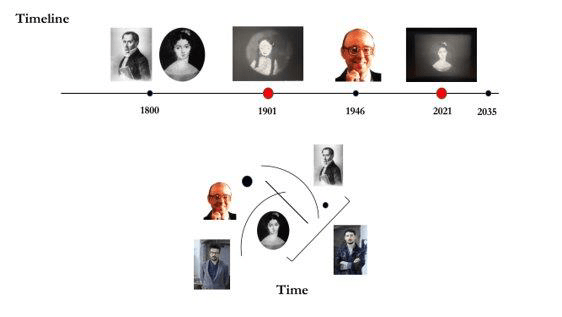
When I researched on the character backgrounds in The Bones, the first thing I noticed is the unreasonable timeline. The film was claimed to be found in 1901, however Jaime Guzmán, one of the main characters based on Chilean history, was born in 1946, 45 years after the film dated. While other two characters, Constanza Nordenflicht and Diego Portales who were a couples died in nineteenth century. The encounter between three of them occurs under the hands of the directors. In Letting Go of Narrative History: The Linearity of Time and the Art of Recounting the Past, Ari Helo wrote “Historians do not simply offer us more or less true representations of the past, but rather create history out of the past” and “There is no necessary connection between the perhaps inescapably narrative character of history and the historian’s absolute commitment to the linearity of time in historical explanation”. I think Cristóbal León and Joaquín Cociña do not work only as the directors in The Bones but also as historians who are aware that history is not just representations of the past but also of the present. The way that they play with the history in an unserious way can reflect their awareness. When they invoke Constanza Nordenflicht from nineteenth century and bring her life again in 2021, Constanza Nordenflicht was not born in 1808 anymore. She was born in a combination of the directors’ knowledge and information that got influences from countless factors. To support my idea, I would like to mention an answer from the directors in an interview here.
Speaking of corpses, non-Chilean audiences (like me) might not know who these two ‘corpses’ are from the film.
León: Actually, they are copies of our bodies. Joaquín is the guy who wears glasses. The other guy looks a bit like me, so we decided that I’d be that guy.
It shows that even the other two main characters are merged with the directors, merging between the past and the present. There is no line between the raw information and the directors’ interpretation. The past is just messy as their own present.
The Power of Reconstruction and Manipulation of History: The manifestation and demonstration of how human perceive and recreate history in The Bones
To talk about the power of The Bones that can efficiently show how a medium of storytelling can reconstruct and manipulate history, from my point of view, I need to spend some time here revealing how the story of the film, which is very simple, allowing the audiences to observe the process of perceiving and receiving information in human. I will begin with describing the actions in the film from an animation director’s point of view and then analyse it in the view of historical field. I will keep discussing both perspectives from the beginning until the end of the film. With these ways of explanation, I hope the relation between animation as a medium to bring life and history as knowledge of recounting the past in The Bones will be noticeable.
To begin with, in the film, the audiences, as observers, are allowed to follow a girl sitting behind a wall. At the back of the broken wall, the audiences see the girl in a room with stage curtains and a backdrop. Starting by seeing her superpowers: using teleportation skill and speed and time controlling skill, the wooden floor is gradually dig without hand touching. The soil ground exposes. The fragments of human bones come out of the underground. Unidentified bones, hand bones, spines and two skulls are scattered on the ground. Then, a wooden palette, a chair, a Greek column are arranged as a place to start a ritual. The girl teleports to sit on the table, ready to begin her performance. For me, while I am watching the introduction of the film, in a metaphor way, I also am seeing the process of a human deciphering and receiving an information from somewhere. The human who has its own power to obtain and interpret the information. The special boundary that no one can invade and he/she has power to choose, edit or control everything he/she wants is shown. Each bone that gradually is dig and moved is like each fragment of information. When these fragments are in her/her hands, he/she is ready to try to understand and interpret them.
The girl starts her performance by playing with the bones. She holds and knocks the bones creating noises and moves them around her as if she is trying to make an acquaintance of. Then, the audiences see her trying to construct the human bones on a chair. During her performance, the audiences see many of her attempts to construct the body, however, based on the audiences’ common knowledge, the body has been being constructed in wrong ways. Hand bones are in the position of legs bones. The pelvis bone is in the chest position, The spine is in the neck bone position and one of the skulls is in the position of the arm bone. For me, I interpret the attempts of construction a body bone as a human who tries to organise information. It is hard to understand fragments of information in the first place and human needs trial and error to find how the information can be making sense. Sometimes it seems right, sometimes it is obviously wrong.
Afterwards, the audiences see her lighting a candle and burning a pile of bones. This time the skins appear and cover all the bones. The skulls have their faces. Hand bones become hands with their skin. Leg bones become more realistic legs. It becomes more obvious that the body bones are male bodies. The glasses on the face, the traces of the two bodies that have been though, somehow, a ritual for dead people: the eyes are sewn, the nose holes are blocked with cotton, are exposed. The hairs can imply the age of the both bodies. Each part of the bodies starts moving around like they have their own life. The audiences can see the girl trying to manipulate the parts of the bodies. To control and not let the head running away, she uses a kind of rope tying the necks and holds the rope on her right hand. She uses her super power, seems like a telekinesis skill, to move the parts of the bodies around and try to construct the body again. This time, the two bodies are more like normal human bodies. The girl continually performs her ritual treating the two bodies like puppets. She becomes a puppeteer manipulating the bodies by strings. Moving the bodies, heads and limbs as she wants. She uses her magic to create some clothes from the air. The clothes are moved and are worn by the bodies. Everything seems almost perfect. The bodies are in the human position. The clothes are worn. The both of the bodies stand side by side each other. Then, the girl creates a heart, an important organ and a symbol of life. The heart is pulsing on her hand and it is put into a chest of a body. With the description above, I interpret the girl’s actions as a human who is recreating some information with his/her interpretation. The information also has its own life which is needed to be commanded. All her superpowers in her ritual are as if the delicate demonstration of how human perceives and manipulates information.
In the last part of the film, the audiences see the two bodies being alive. However, still, the two bodies are under the girl’s control. The audiences can see the strings all over both bodies. The two bodies are manipulated as the girl’s desire until the end of the film. When the girl teleports away from the screen. The two bodies stop moving, standing still and laying down on the ground. They cannot move anymore. The film shows the time has passed by some snow covering up the bodies. For me, what I can say is that when there is no one manipulates information, or another word, history, the information is like a dead body. Stand still and wait for someone who is interested in them and reconstruct and manipulate them by another interpretation. To be alive again.
The film design
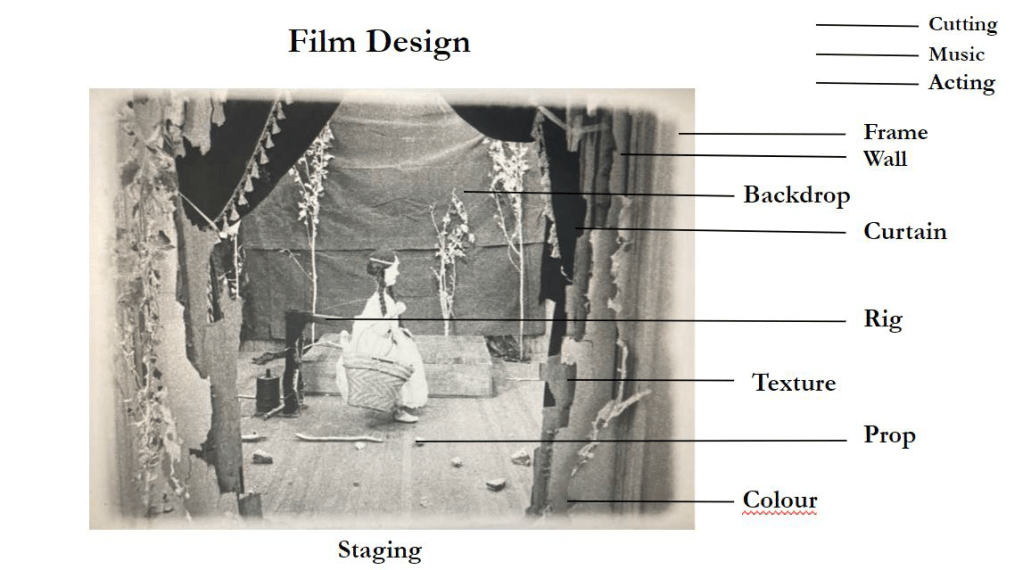
I chose the shot above from the film to analyse and deconstruct as I think it is one of the interesting shots to talk about. It seems like a common shot, a shot of a walking girl. But it is also the only shot that the audiences can see the rig holding the armature of the girl. For me, the film design takes an important role to portray the ideas and concepts of the film. With the delicate thoughts and works, the audiences can appreciate the visual language and follow the story in a special condition. Here, I would like to deconstruct this shot to explain how each elements function to each other and to the audiences. Firstly, the frame. The audiences can see some empty space between the rectangle screen and the screened film. This implies to the audiences that they are watching a film which is being screen. The audiences are not entirely dragged into the animation world but are consciously aware that they are watching a film. With the black and white colour combined with the texture of dust inform the audiences that the film was shot by an old analog film. There are no rushing cuts and the scenes often go on and on like films in the early cinemas. It makes the film reliable regarding the claimed to be the first stop motion animation in the world. In terms of composition, the shot is organised as a stage play. The audiences see the broken wall in the foreground as they are peeping the character but, at the same time, they are seeing the black curtains which seem like the curtains being used on stage. When these come with the symmetry, centred composition, the audiences can get a sense of watching a classical play in theatre. Again, it means that the audiences are watching a character on stage which means they know that everything on stage is being performed. Nothing is real. To support the sense that everything is made up and not real, all the elements in the shots such as rocks, wooden sticks and trees are arranged in an unnatural way. Everything was purposely and intentionally arranged, in other word, faked. The backdrop which is the background also gives the more depth of the stage feeling. It shows to the audiences that they are not just watching the play on stage but, probably, they are also watching the character preparing, performing or rehearsing on the backstage. The rig using to hold the girl is obviously shown, without hiding. All these elements convince the audiences to feel that they are watching a made-up animation story even the film claims that it somehow relates to Chilean history. Compared to general historical films which mostly trying to portray the realistic or absolute truth and trying to bring the audience into the fiction world, The Bones is in the opposite way. The film does not underestimate the audiences’ awareness. Being and obeying in the made-up world is not the directors’ intention at all.
The Bones as an individual historical conservation
Most parts of the essay, I spend time to deconstruct and analyse elements in The Bones in a way that I think they are related to the historical knowledge in both as an animation filmmaker and as an audience. As I believe that The Bones creates a free space for an ordinary people to work on historical material compared to historians or people who directly work on historical evidence that have many conditions and restrictions to be aware of. For me, The Bones, as an animated form, conserves history with no difference mainstream/national history/meta-narrative history, if I need to juxtapose them. The contribution that The Bones gives to the body of animation deserved to be written and shared.
I use the word remnant, instead of fragments, in the topic of the essay because I think it is hard to say that any material is completed fragments in itself. The Bones and/or other work pieces related to history always work on parts of fragments as human always work with the remnant of the past and never work on any complete or entire piece of things.
In conclusion
Even the film is claimed to be related to the history of animation and of Chile, The Bones does not inform or give any historical knowledge and has no intention to give any absolute truth in history at all. In the opposite way, the directors’ ways of working, the playful directions of the film, the actions of the characters and the film design give the audiences a sense of skepticism and untrustworthy. In these senses, as an animation that communicates with people using history as part of the film, I think The Bones create a means for history to be interpreted by anyone with their own interpretation.
Reference
Collingwood, R., 1989. The Idea of History. Oxford: Oxford University Press.
Fear, C., Hampsher-Monk, I. and Skidelsky, E., n.d. Old problems re-opened.
Helo, A., 2016. Letting Go of Narrative History: The Linearity of Time and the Art of Recounting the Past. European journal of American studies, 11(2).
MUBI. 2022. The Bones. [online] Available at: https://mubi.com/films/the-bones [Accessed 4 March 2022].
Robinson, C., 2022. Interview: Joaquín Cociña And Cristóbal León Discuss Their New Short ‘Los Huesos,’ Premiering Today At Venice Film Fest. [online] Cartoon Brew. Available at: https://www.cartoonbrew.com/interviews/interview-joaquin-cocina-and-cristobal-leon-discuss-their-new-short-los-huesos-premiering-today-at-venice-film-fest-208571.html [Accessed 4 March 2022].
 Home
Home 